
LightRAG — Graph RAG nhẹ, nhanh và cập nhật tăng dần
HKUDS/LightRAG — bắt đầu bằng cách tiếp cận, cài đặt, ứng dụng; các phần sau đi sâu vào thành phần và kỹ thuật.Tổng quan Intro
LightRAG là một graph-based RAG framework của HKUDS. Thay vì chỉ lưu chunks trong vector DB như NaiveRAG, LightRAG extract entity và relationship từ từng chunk, lưu graph + vector representations, rồi query bằng hai tầng: low-level cho entity cụ thể và high-level cho relationship/theme rộng hơn. Mục tiêu là giữ được context multi-hop mà không phải đi theo hướng community-report nặng như GraphRAG.
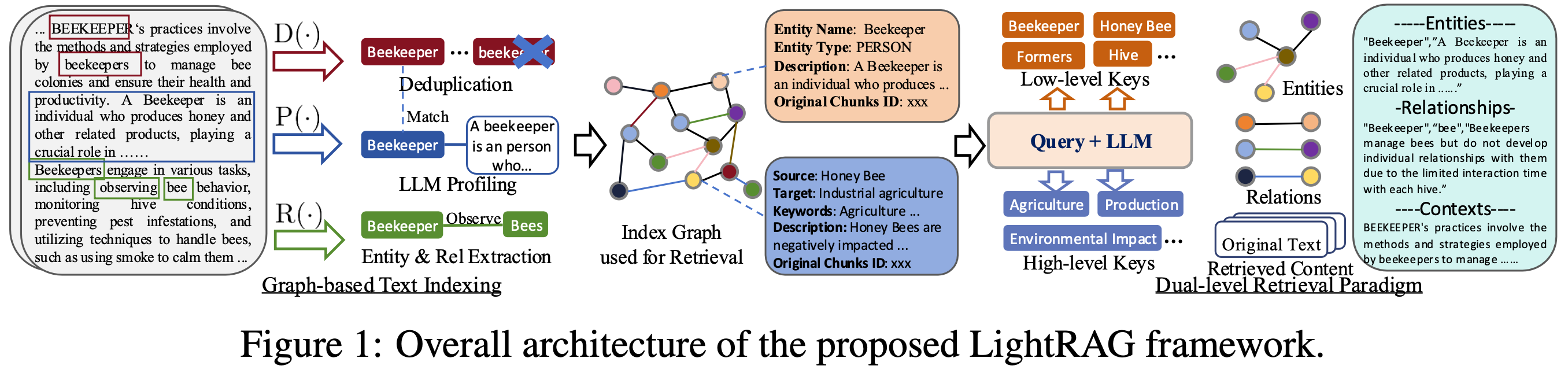
mix mode, và pipeline vận hành có concurrency/cancellation/status rõ ràng.
Cách tiếp cận Approach
LightRAG giải quyết một trade-off phổ biến trong RAG: flat vector chunks nhanh và đơn giản nhưng yếu với câu hỏi cần quan hệ nhiều bước; GraphRAG giàu ngữ cảnh nhưng community traversal và report regeneration có chi phí cao. LightRAG chọn hướng trung gian: xây graph nhỏ hơn, query bằng vector search trên entity/relation keys, rồi chỉ lấy subgraph/chunks cần thiết.
| Khía cạnh | NaiveRAG | GraphRAG | LightRAG |
|---|---|---|---|
| Index artifact | Vector chunks | Entity graph + community reports | Entity/relation graph + vector stores |
| Query target | Nearest chunks | Community summaries + graph traversal | Entity keys, relation keys, chunks |
| Update mới | Add chunks | Có thể phải rebuild community reports | Merge incremental entities/relations |
| Điểm mạnh | Đơn giản, latency thấp | Global summaries tốt | Cân bằng local detail và global relation |
| Điểm yếu | Mất relation structure | Chi phí retrieval/update cao | Phụ thuộc LLM extraction và embedding/rerank quality |
- Đừng đọc như một vector DB wrapper; hãy đọc như graph artifact builder cộng với query context compiler.
- Nếu corpus không có entity/relation đáng kể, LightRAG có thể là overkill so với NaiveRAG.
- Nếu corpus thay đổi liên tục, incremental merge là lý do chính để cân nhắc LightRAG thay GraphRAG.
Cài đặt Setup
Có hai cách dùng chính: chạy server/API/WebUI như một dịch vụ độc lập, hoặc embed LightRAG Core
vào ứng dụng Python. Repo hiện khuyến nghị uv, nhưng vẫn hỗ trợ pip.
- 1Chọn mode triển khai
Dùng server nếu muốn WebUI, API, document upload, graph exploration và Ollama-compatible endpoints. Dùng core nếu bạn đang viết app Python hoặc nghiên cứu thuật toán.
uv tool install "lightrag-hku[api]" # hoặc: uv pip install lightrag-hku - 2Tạo cấu hình model/storage
Dùng wizard để tạo .env thay vì sửa tay toàn bộ. Bước bắt buộc đầu tiên là LLM, embedding và reranker.
make env-base make env-storage make env-server make env-security-check - 3Chạy server hoặc core
Server đọc .env ở startup directory; core cần initialize_storages trước khi insert/query.
lightrag-server
# production non-Windows: lightrag-gunicorn --workers 4
Core API tối giản
import asyncio
from lightrag import LightRAG, QueryParam
from lightrag.llm.openai import gpt_4o_mini_complete, openai_embed

async def main():
    rag = LightRAG(
        working_dir="./rag_storage",
        llm_model_func=gpt_4o_mini_complete,
        embedding_func=openai_embed,
    )
    await rag.initialize_storages()
    try:
        await rag.ainsert("Your text")
        answer = await rag.aquery(
            "What are the top themes?",
            param=QueryParam(mode="mix"),
        )
        print(answer)
    finally:
        await rag.finalize_storages()

asyncio.run(main())bge-m3 sang text-embedding-3-large,
cần recreate vector storage thay vì chỉ đổi env var.
Ứng dụng Use cases
LightRAG phù hợp nhất khi câu hỏi cần tổng hợp entity/relation qua nhiều tài liệu. Nếu chỉ cần hỏi đáp một vài file ngắn, chi phí graph extraction có thể không đáng. Nếu tài liệu dài, nhiều quan hệ, và cần cập nhật tăng dần, LightRAG có lợi thế rõ.
| Use case | Vì sao hợp | Lưu ý |
|---|---|---|
| Legal | Hợp đồng, compliance, governance | Multi-hop |
| Tech Docs | Tài liệu kiến trúc, runbook, dependency graph | Ops |
| Research | Paper corpus, entity/concept relations, literature review | Research |
| Product | FAQ + docs + changelog cần cập nhật liên tục | Incremental |
Ưu điểm
- Tốt cho câu hỏi cần liên kết nhiều entity/relation thay vì chỉ retrieve top-k chunks.
- Có server/WebUI sẵn để thử nhanh, graph exploration, upload và query.
- Storage backend đa dạng: local JSON/NetworkX cho dev, PostgreSQL/Neo4j/Milvus/Qdrant/OpenSearch cho production.
- Có đường tiến hóa rõ: rerank, references, Langfuse tracing, RAGAS evaluation, RAG-Anything multimodal.
Nhược điểm
- Indexing tốn LLM calls và nhạy với chất lượng extraction.
- Model nhỏ hoặc reasoning model dùng sai stage có thể tạo graph noisy hoặc chậm.
- Cần quản trị schema embedding/storage nghiêm túc để tránh mismatch khi vận hành.
- Không thay thế exact citation pipeline nếu yêu cầu audit từng claim ở mức chunk/source nghiêm ngặt.
Bảng tóm tắt kỹ thuật Overview
| ID | Kỹ thuật | Theme |
|---|---|---|
| T1 | Graph-based text indexing | Indexing |
| T2 | Incremental graph update | Indexing |
| T3 | Dual-level retrieval | Retrieval |
| T4 | Mix mode: KG + vector chunks | Retrieval |
| T5 | Token budget + context compiler | Context |
| T6 | 4-way storage abstraction | Storage |
| T7 | Server/API/WebUI + setup wizard | API |
| T8 | Rerank + references | Quality |
| T9 | Concurrent control hierarchy | Ops |
| T10 | Observability, cache, evaluation | Ops |
Thành phần và kỹ thuật chuyên sâu Deep
1. Graph-based text indexing
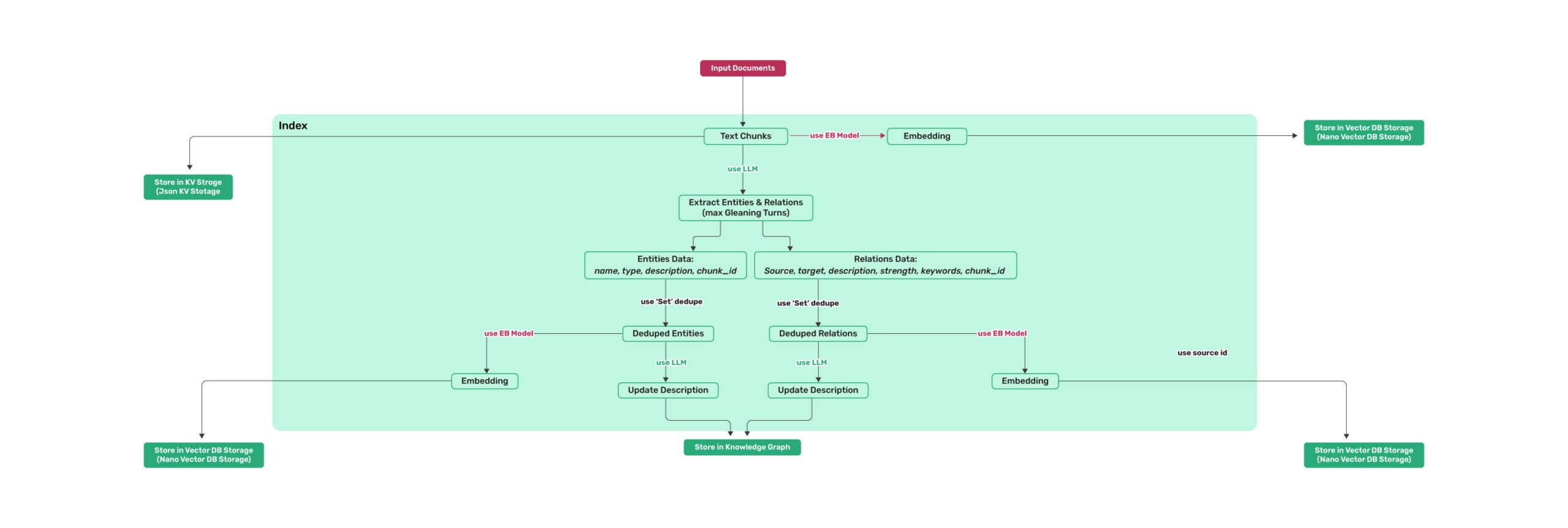
T1Pipeline gồm chunking, entity/relation extraction, parse output, merge duplicate nodes/edges, và upsert vào cả graph store lẫn vector stores. Entity dùng tên làm key; relation có keywords và description để hỗ trợ high-level retrieval.
Chunking theo token size — lightrag/operate.py
def chunking_by_token_size(
    tokenizer,
    content,
    split_by_character=None,
    split_by_character_only=False,
    chunk_overlap_token_size=100,
    chunk_token_size=1200,
):
    tokens = tokenizer.encode(content)
    results = []
    for index, start in enumerate(
        range(0, len(tokens), chunk_token_size - chunk_overlap_token_size)
    ):
        chunk_content = tokenizer.decode(tokens[start : start + chunk_token_size])
        results.append({
            "tokens": min(chunk_token_size, len(tokens) - start),
            "content": chunk_content.strip(),
            "chunk_order_index": index,
        })
    return results
Ưu điểm
- Giữ được relation structure thay vì chỉ similarity chunks.
- Entity/relation có thể query độc lập qua vector stores.
- Graph artifact có thể visualize, export và rebuild một phần.
Nhược điểm
- Indexing phụ thuộc LLM extraction; model yếu tạo noisy graph.
- Chi phí insert cao hơn NaiveRAG vì phải gọi LLM trên chunks.
- Cần kiểm soát entity types, delimiter và source metadata.
Phân tích sâu: indexing pipeline, extraction parser, merge và incremental update
2. Incremental graph update
T2Trong source, insert không ghi thẳng vào graph một cách ad-hoc. Nó đi qua queue, status storage, pipeline lock và merge helpers. Khi document deletion xảy ra, các entity/relation bị ảnh hưởng được rebuild từ chunks/cache còn lại để tránh stale source.
3. Dual-level retrieval
T3
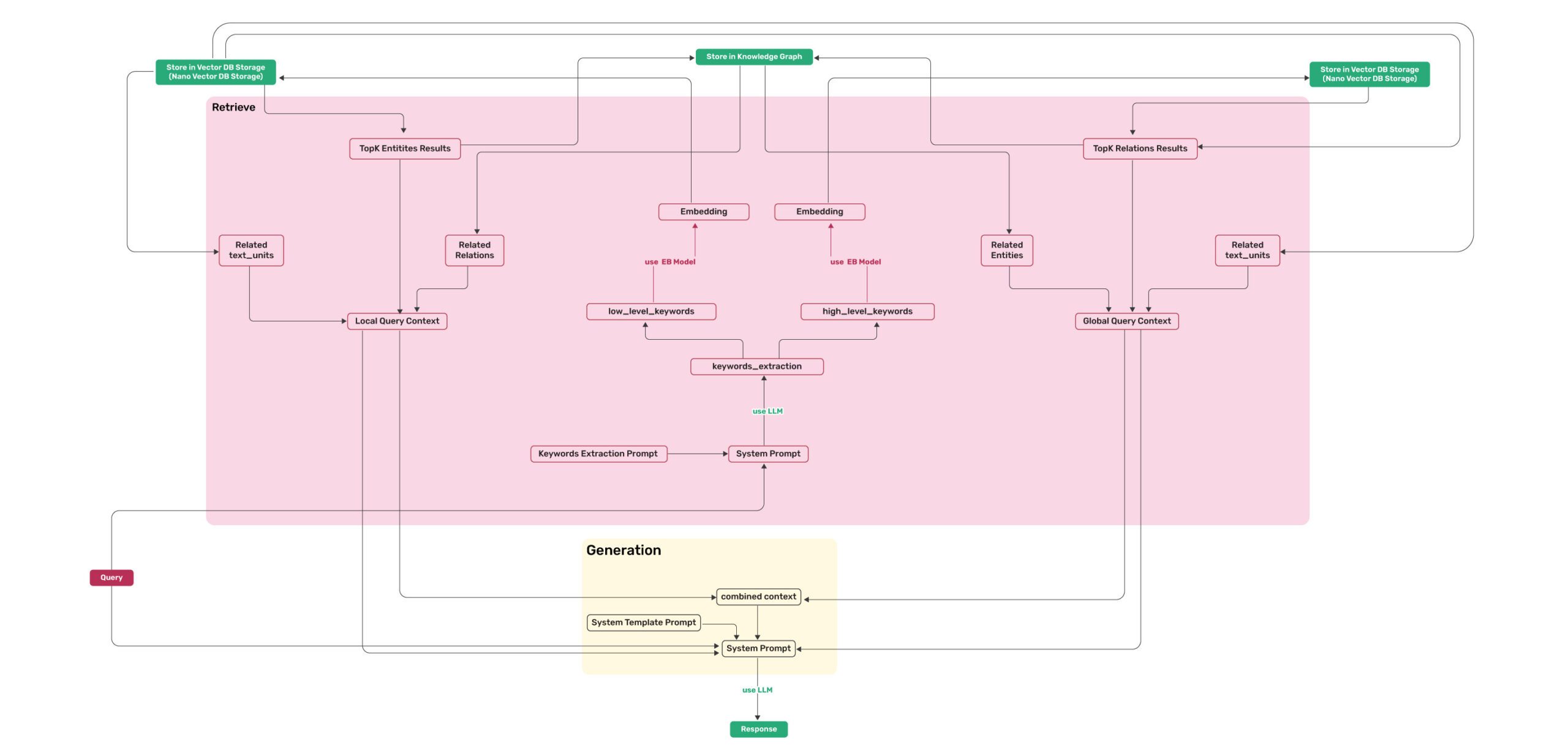
Paper mô tả low-level retrieval cho câu hỏi cụ thể như entity facts, còn high-level retrieval cho
câu hỏi abstract. Source hiện thực hóa bằng ll_keywords và hl_keywords:
local branch query entities_vdb, global branch query relationships_vdb.
QueryParam modes — lightrag/base.py
@dataclass
class QueryParam:
    mode: Literal["local", "global", "hybrid", "naive", "mix", "bypass"] = "mix"
    only_need_context: bool = False
    only_need_prompt: bool = False
    response_type: str = "Multiple Paragraphs"
    stream: bool = False
    top_k: int = int(os.getenv("TOP_K", str(DEFAULT_TOP_K)))
    chunk_top_k: int = int(os.getenv("CHUNK_TOP_K", str(DEFAULT_CHUNK_TOP_K)))
    enable_rerank: bool = os.getenv("RERANK_BY_DEFAULT", "true").lower() == "true"
    include_references: bool = False
Ưu điểm
- Local branch trả lời tốt câu hỏi entity/detail.
- Global branch mở rộng sang relationships và themes.
- Hybrid/mix cân bằng breadth/depth tốt hơn single mode.
Nhược điểm
- Keyword extraction sai làm retrieval lệch hướng.
- High-level relation VDB phụ thuộc relation keywords do LLM tạo.
- Cần tune top_k/chunk_top_k/token budget theo corpus.
Phân tích sâu: query modes, keyword extraction, mix mode, rerank và context build
4. Mix mode: KG + vector chunks
T4mix là default thực dụng. Nó không bắt người dùng chọn giữa graph
và chunks: local/global graph search lấy entities/relations, direct vector search lấy chunks
có semantic match cao, rồi merge/dedupe trước khi build prompt.
Mix branch trong search — lightrag/operate.py
if query_param.mode == "mix" and chunks_vdb:
    vector_chunks = await _get_vector_context(
        query,
        chunks_vdb,
        query_param,
        query_embedding,
    )
    for i, chunk in enumerate(vector_chunks):
        chunk_id = chunk.get("chunk_id") or chunk.get("id")
        if chunk_id:
            chunk_tracking[chunk_id] = {
                "source": "C",
                "frequency": 1,
                "order": i + 1,
            }
5. Token budget + context compiler
T5Stage 4 tính trước system prompt tokens, KG context tokens, query tokens và buffer. Phần token còn lại mới cấp cho chunks. Đây là pattern đáng học: context compiler phải biết overhead, không chỉ truncate theo một constant cố định.
6. 4-way storage abstraction
T6| Storage role | Default dev | Production options | Dùng để làm gì |
|---|---|---|---|
| KV | JsonKVStorage | PostgreSQL, Redis, MongoDB, OpenSearch | Full docs, text chunks, caches, entity/relation metadata |
| Vector | NanoVectorDBStorage | PGVector, Milvus, Qdrant, Faiss, MongoVector, OpenSearch | Entities, relationships, chunks semantic search |
| Graph | NetworkXStorage | Neo4j, PostgreSQL AGE, Memgraph, OpenSearch | Nodes, edges, degree, traversal, subgraph |
| Doc status | JsonDocStatusStorage | PostgreSQL, MongoDB, OpenSearch | Pending/processing/processed/failed và pipeline monitoring |
Storage objects được tạo trong __post_init__ — lightrag/lightrag.py
self.text_chunks = self.key_string_value_json_storage_cls(
    namespace=NameSpace.KV_STORE_TEXT_CHUNKS,
    workspace=self.workspace,
    embedding_func=self.embedding_func,
)
self.chunk_entity_relation_graph = self.graph_storage_cls(
    namespace=NameSpace.GRAPH_STORE_CHUNK_ENTITY_RELATION,
    workspace=self.workspace,
    embedding_func=self.embedding_func,
)
self.entities_vdb = self.vector_db_storage_cls(
    namespace=NameSpace.VECTOR_STORE_ENTITIES,
    workspace=self.workspace,
    embedding_func=self.embedding_func,
    meta_fields={"entity_name", "source_id", "content", "file_path"},
)Phân tích sâu: storage backend matrix, API server, WebUI, Docker và setup wizard
7. Server/API/WebUI + setup wizard
T7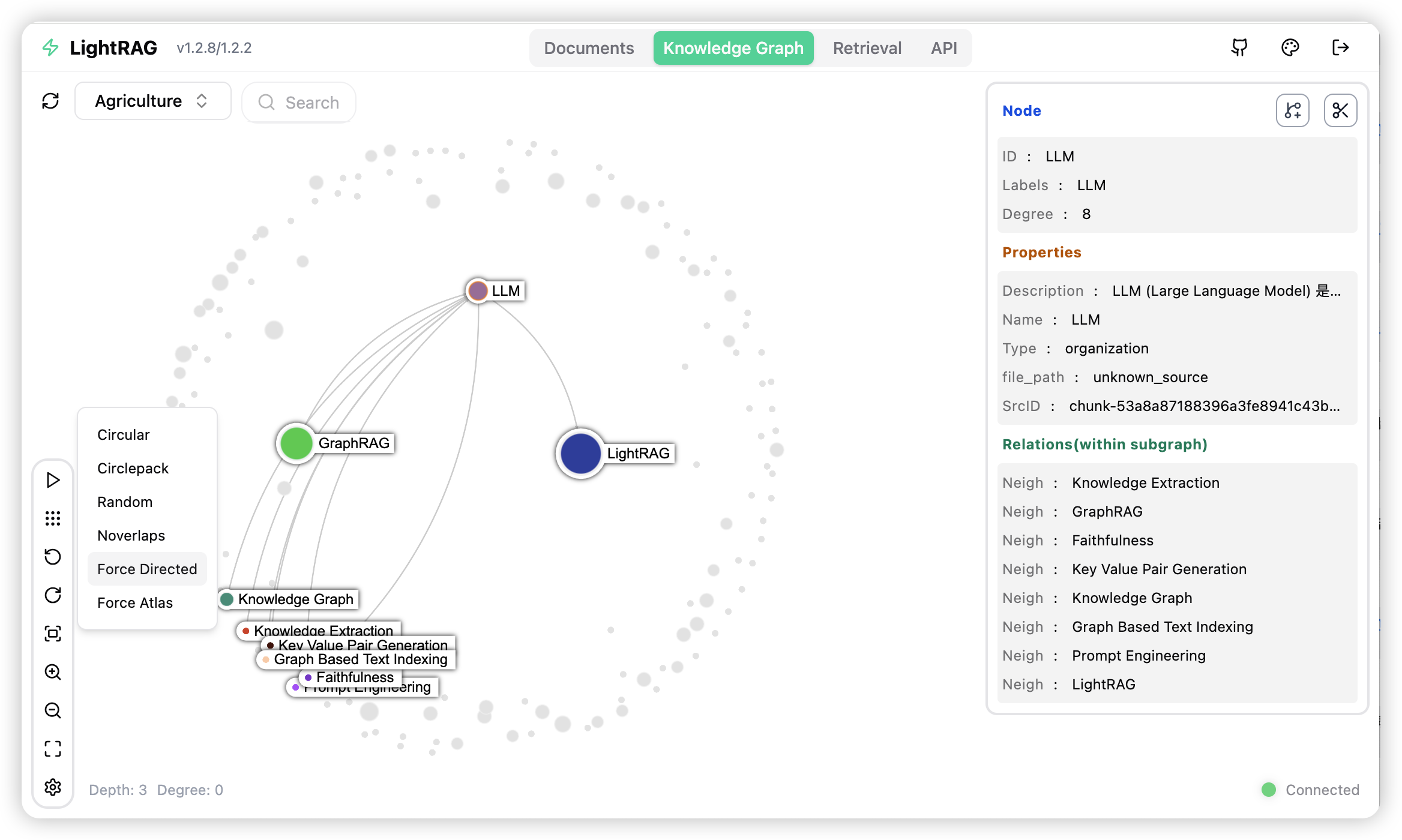
env.example thủ công,
có thể chạy make env-base, make env-storage, make env-server
và make env-security-check.
8. Rerank + references
T8mix mode và corpus có chunks dài.
`rerank.py` có helper chunk documents vượt token limit trước khi gọi rerank API, rồi aggregate
scores về document gốc bằng max, mean hoặc first. Đây là
chi tiết nhỏ nhưng quan trọng khi reranker có max 512 tokens/doc.
Rerank long documents — lightrag/rerank.py
def aggregate_chunk_scores(chunk_results, doc_indices, num_original_docs, aggregation="max"):
    doc_scores = {i: [] for i in range(num_original_docs)}
    for result in chunk_results:
        chunk_idx = result["index"]
        score = result["relevance_score"]
        if 0 <= chunk_idx < len(doc_indices):
            doc_scores[doc_indices[chunk_idx]].append(score)

    aggregated_results = []
    for doc_idx, scores in doc_scores.items():
        if not scores:
            continue
        final_score = max(scores) if aggregation == "max" else sum(scores) / len(scores)
        aggregated_results.append({"index": doc_idx, "relevance_score": final_score})
    return sorted(aggregated_results, key=lambda x: x["relevance_score"], reverse=True)
9. Concurrent control hierarchy
T9Ưu điểm
- Có pipeline_status để monitor busy/request_pending/cancellation.
- Query user được ưu tiên hơn extraction/merge.
- Giới hạn max_parallel_insert giảm conflict entity naming giữa files.
Nhược điểm
- Set concurrency quá cao không chắc nhanh hơn vì LLM queue vẫn là bottleneck.
- Parallel document insert tăng chi phí rollback/retry nếu nhiều file đang midway.
- Local LLM cần tính context length và throughput trước khi nâng MAX_ASYNC.
Phân tích sâu: concurrency, deletion/rebuild, cache, tracing và failure modes
10. Observability, cache, evaluation
T10| Capability | Dùng khi nào | Ghi chú |
|---|---|---|
| TokenTracker | Theo dõi token usage khi insert/query batch | Hữu ích để phát hiện extraction cost bất thường |
| Graph export | Backup, audit, phân tích ngoài LightRAG | CSV, Excel, Markdown, TXT |
| Cache management | Debug query cache/extraction cache | aclear_cache() xóa toàn llm_response_cache; query cache có tool riêng |
| Langfuse | Trace LLM calls OpenAI-compatible | Chưa cover mọi backend như Ollama/Azure/AWS Bedrock |
| RAGAS | Đánh giá RAG quality/context precision | Có script evaluation riêng trong repo |
Decision matrix Decision
| Tình huống | Nên dùng LightRAG? | Lý do |
|---|---|---|
| Corpus nhỏ, Q&A đơn giản | Không ưu tiên | NaiveRAG hoặc full-text/vector search đơn giản đủ và rẻ hơn. |
| Corpus nhiều entity/relation | Có | Graph indexing giúp câu hỏi multi-hop tốt hơn top-k chunks. |
| Data cập nhật liên tục | Có | Incremental graph merge tránh rebuild toàn bộ community reports. |
| Yêu cầu exact citation strict | Cân nhắc | LightRAG có references, nhưng cần kiểm soát audit pipeline riêng nếu compliance nghiêm ngặt. |
| Team chưa có LLM/embedding ops | Prototype trước | Dễ chạy demo, nhưng production cần quản lý model, storage, cache, trace và backup. |
Tổng kết Wrap
LightRAG đáng nghiên cứu vì nó gom nhiều bài học engineering của graph RAG vào một implementation tương đối gọn: graph-based indexing, dual-level retrieval, mix mode, storage abstraction và pipeline vận hành có concurrency/status rõ ràng. Điểm mạnh chính là corpus động và câu hỏi multi-hop; điểm yếu chính là chi phí/chất lượng extraction.
- Dùng LightRAG khi corpus có quan hệ rõ và cần cập nhật tăng dần.
- Bắt đầu bằng server/WebUI để quan sát graph trước khi embed core vào app.
- Production phải khóa embedding model, setup trace/evaluation, và tune concurrency theo LLM backend.
- Nếu chỉ cần chatbot hỏi tài liệu ngắn, LightRAG là dư thừa.